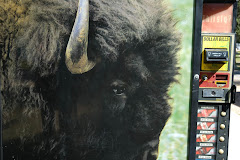
The summer of 2004 my parents, younger brother, and I took a vacation to one of dad’s favorite childhood vacation spots, South Dakota. The plan was to drive the ten hours to Custer, SD and spend two weeks camping at the Beaver Lake Campgrounds. My dad invited his sister, her husband, and their three kids to join us as well. I spent weeks bragging to my friends about my plans to see Mount Rushmore, Crazy Horse, and all the parks we had learned about in our textbooks. In my mind, I was planning an adventure into the wild, or at least as wild as it gets for a fourteen year old. I had my bags packed to the brim and barely had room for all my little disposable cameras. I wasn’t going to miss a single wild moment of this trip. Little did I know but this trip was going to change my life.
Monday, March 29, 2010


Sunday, March 28, 2010
Personal Essay Intro Paragraph
A New Approach
Friday, March 26, 2010
Casey Project
(see www.ecomfa.engl.iastate.edu)
Habitat Management
Jessamy
Cody
Jarred
Qi
Outdoor-Classroom Plan
Alex
Yao
Nick
Creek Management Plan
Macy
Troy
Mark
Kyle
Prairie-Restoration Plan
Tacie
Ramsay
Crystal
Ben
History
Yasmine
Matt
Wes
James
Project Requirements
• A map
• A four-page-minimum written summary, with at least three outside sources, one of them primary; at least eight concrete steps toward accomplishing the plan; or, in the case the History group, eight specific historical developments
• A visual: a chart, a graph, photographs, etc.
• An ten-minute oral presentation involving all group members.
• The plan should be of professional quality, on a level that could be presented to the university.
Field Trip, Saturday, March 27, 10:00-2:00
Meet at the the Transit Hub in the parking lot to the south of Stephen’s Auditorium and north of the football stadium:
http://www.fpm.iastate.edu/maps
Come prepared to get dirty and wet. You should consider bringing a rain coat..
Bring pen and paper.
Consider bringing:
Field guides
Camera
Lunch
Tuesday, March 9, 2010
Journal: Smokey the Bear Sutra by Gary Snyder
It seems that Gary Snyder has used Smokey the Bear in order to support his political beliefs such as when he says, “Trampling underfoot wasteful freeways and needless suburbs; smashing the worms of capitalism and totalitarianism;” and also when he says “Wearing the blue overalls symbolic of slaves and laborers, the countless men oppressed by a civilization that claims to save but only destroys.” He uses small gestures from a character and gives them radical meanings. He gives Smokey the Bear a kind, enlightenment in some points like when he says “Smokey the Bear will Illuminate those who would help him,” but then goes on and give the character a violent side directed to people who don’t agree saying “HE WILL PUT THEM OUT.” I think this is an ironic thing to do because he explains that he doesn’t like totalitarianism in the United States but I think in a way he is being as authoritative in his writing as a totalitarian would be over a country.
Journal: Having Faith by Sandra Steingraber
As a woman, I feel that Sandra Steingraber’s piece, Having Faith, is very important. It explains how much harm you can do to your own body as well as your children if you pass on these pesticides from your food to your breast milk. I think Steingraber is right in wanting this information to be explained to people everywhere, especially women because it so intimately affects their lives and the lives of those most important to them. I think it is right to explain to people the harm in pesticides so that women no longer have to be afraid to breast feed, which should really be the healthiest thing for their babies. As long as farmers use chemicals to grow their food, however, we can’t make the steps to living a healthier life, therefore women need to push the importance of organic foods and educate others.
Journal: Silent Spring by By Rachel Carson
I like the way Rachel Carson begins her piece with “A Fable for Tomorrow.” It makes her point of view very clear and shows exactly what she believes is the perfect way to live in the perfect town. She shows that perfect town, with “fields of grain and hillsides of orchards where, in spring, white clouds of bloom drifted above the green fields,” and then explains all the things that could go wrong, such as the day no birds sang and the voices of no animal could be heard all because they had died from pesticides. This clear introduction set up nicely for her to explain how pesticides are killing animals and that although there is no town in America who has seen all the animals die like in the fable, every town has suffered from at least one of the horrible deaths of animals. I think with the mix of the story and the facts and anecdotes, Carson was able to change the way people think about pesticides and how they affect the environment.